The US labor market delivered a surprise. The report published on August 7 showed a loss of 23,000 jobs versus forecasts for a gain of 80–88,000, while May and June data were revised down by a total of 103,000 jobs. The unemployment rate fell to 4.1% from 4.2%, but only because people left the labor force — the participation rate fell to 61.4%.
The probability of a Fed rate hike in September plunged from 55% to 44%, and two-year Treasury yields fell by 8 basis points. Treasuries rallied sharply, and the dollar index declined.
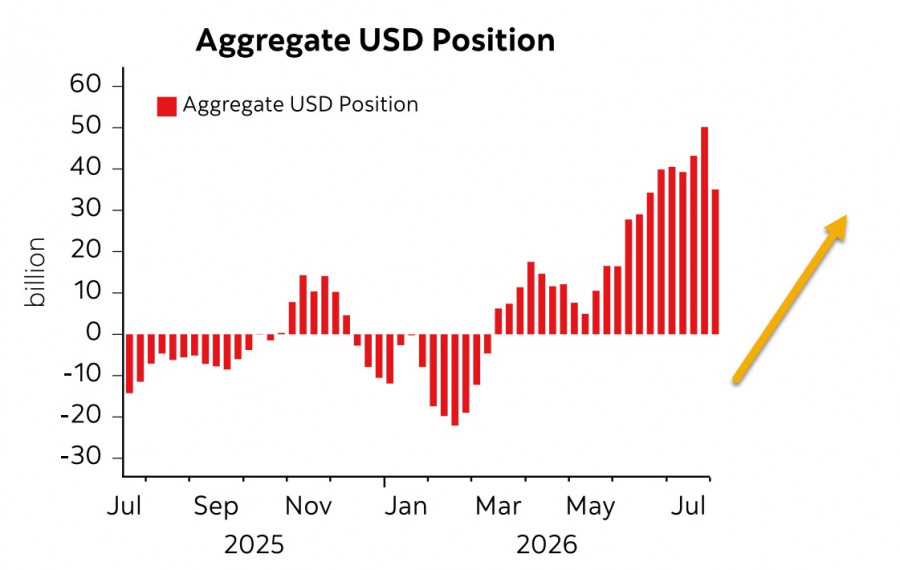
Friday's CFTC report reflected a rapid shift in speculative positioning: the aggregate long position in USD was cut by $12.5 billion in the reporting week to $35.9 billion — the fastest weekly reduction in almost two years. The reduction came mainly via the Japanese yen: after currency intervention, speculators trimmed JPY short positions by 117,939 contracts, equivalent to about $9.4 billion.
Those are two powerful bearish factors for the dollar, yet its reaction has been fairly muted. The reason is geopolitics.
The conflict around the Strait of Hormuz is not a "nuclear" problem — that label is just a pretext. The real US goals lie in control over global energy flows.
Last week, Iran's parliament approved a law banning passage of US and Israeli ships through the Strait of Hormuz, and Tehran issued Washington a five-point ultimatum: reparations for war damage, an end to threats and aggression, lifting of sanctions and any naval blockade, and unfreezing of frozen assets. Oman's agreement on new shipping routes is close to completion, but Iranian leaders make clear that "this agreement alone is not enough."
Markets are gradually losing faith in a "quick peace." Brent rose to $84.46, and the dollar remains a winner in virtually any scenario.
Scenario A: The US bends Iran. Washington secures control over the Strait of Hormuz, gains the ability to regulate global energy flows and cements geopolitical dominance in the region. That would strengthen the US position globally, boost confidence in the dollar as the reserve currency, and attract capital into US assets.
Scenario B: Escalation and blockade. If no agreement is reached, the US will continue to block Iranian exports and provoke higher oil prices. That would inflict severe economic damage on Europe, Japan, and other energy-importing countries. The dollar would strengthen as a safe-haven currency and because the US economy would be relatively less dependent on oil imports than its rivals.
The US has room to maneuver. It could pass through its own economic crisis without a dollar collapse — simply because other countries could be worse off.
The technical picture for the dollar index remains ambiguous. The index has lost more than 2.3% from its yearly highs and has broken the rising trend from May. A weak labor market rules out immediate Fed tightening, which limits dollar upside. But geopolitical uncertainty and high oil prices support demand for safe assets. The index is likely to trade near current levels while markets await new inflation data and geopolitical signals.
If geopolitics intensify and inflation expectations begin to rise again, markets could reassess the probability of a Fed rate hike — a bullish scenario for USD. The bearish alternative — easing geopolitical risks and softer-than-expected inflation data — would remove both supports for the dollar, but that outcome currently looks less likely than the bullish one.
Bottom line: The US dollar remains in a zone of uncertainty. Weak labor market data and lower odds of a rate hike exert downward pressure, but the geopolitical factor continues to underpin the USD. Given that the Iran conflict favors the dollar under almost any outcome, and technical indicators point to range trading, the most probable scenario is consolidation around current levels with short-term spikes in volatility.




















 コンタクトする