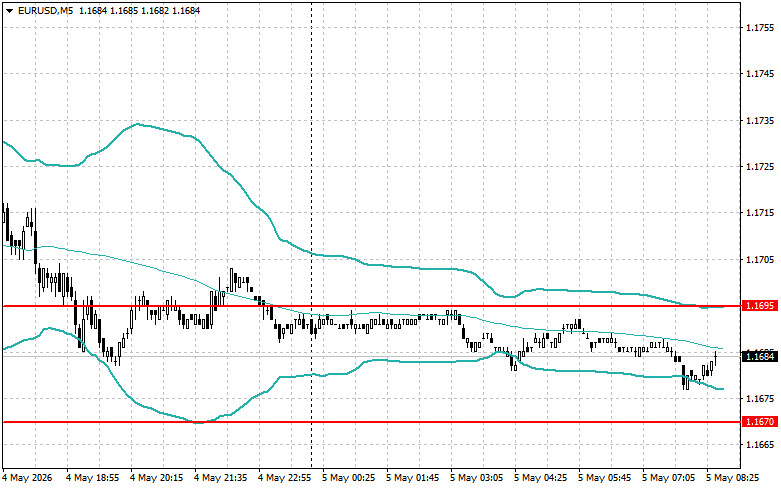
The US dollar continued to strengthen against risk assets amid ongoing tensions in the Middle East.
Yesterday, information surfaced that Iran attacked a US warship attempting to pass through the Strait of Hormuz, and various sources reported that Tehran is actively shelling the UAE with missiles. It is evident that all of this could escalate into a larger military confrontation at any moment.
Today's trading day promises to be eventful, despite the lack of significant macroeconomic data from the Eurozone in the first half of the day. All market participants will be focused on two key events: the meeting of the EU Finance Ministers and the upcoming speech by European Central Bank President Christine Lagarde.
These meetings typically serve as platforms for discussing key economic issues, formulating coordinated policy decisions, and shaping future directions for monetary policy. The Finance Ministers' Council, the main body responsible for economic and financial policy in the Eurozone, may consider a wide range of topics, including budget coordination, financial stability, and issues related to the current challenges facing the European economy, such as high energy prices and inflation. Any hints at changes in fiscal policy or new initiatives could significantly impact investor sentiment and the dynamics of currency pairs.
Market participants will pay particular attention to Christine Lagarde's words. Her speeches often contain valuable signals about the ECB's future actions, especially regarding interest rates and other monetary policy tools. In the current economic uncertainty, any deviation from previously stated positions or, conversely, confirmation of a hawkish rhetoric could lead to noticeable volatility in financial markets, particularly in euro pairs. Lagarde is expected to address inflation, economic growth, and the measures being taken to maintain price stability.
If the data aligns with economists' expectations, it is better to act based on the Mean Reversion strategy. If the data turns out to be significantly higher or lower than economists' expectations, the Momentum strategy would be the most suitable.
SZYBKIE LINKI




















 Skontaktuj się z ForexMart