The wave count on the four-hour chart for EUR/USD has become more complex. On the higher time frame (bottom chart), the downward trend segment has taken the form
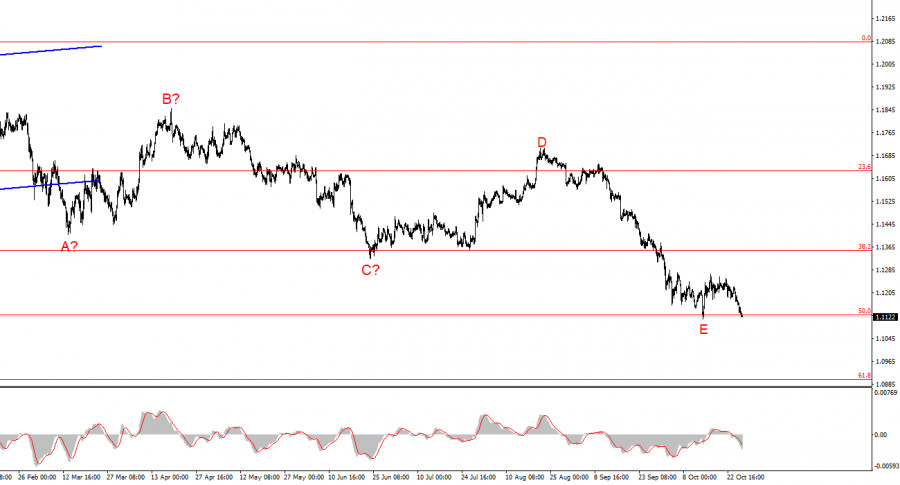
The wave count on the four-hour chart for EUR/USD has become more complex. On the higher time frame (bottom chart), the downward trend segment has taken the form of a five-wave structure labeled A-B-C-D-E, which may be complete at any moment, as it appears well developed. All waves within this segment are approximately equal in size, suggesting that it is corrective. If this assumption is correct, the completion of this structure will be followed by the development of an impulsive upward trend segment, with targets well above the 20 level.
On the lower time frame (top chart), an impulsive wave sequence continues to develop and may belong to wave E on the higher time frame. If this is indeed the case, the dollar's strengthening is nearing its end, regardless of how much further it appreciates. The projected wave 5 of E is either complete or approaching completion. In either case, the current wave structure suggests that the downward wave sequence is nearing completion on both charts. News developments and a sharp shift in market sentiment have driven a strong rally in the US dollar, but few new factors remain to support further appreciation.
The EUR/USD exchange rate fell by another 50 basis points on Tuesday, which probably no longer surprises anyone. The ECB and the Fed are scheduled to hold meetings this week, but the market appears largely uninterested in them. Market participants already know how the central banks will act in the near future and do not need any further guidance. At least, that is the impression created by the instrument's price movements. The market, in general, is not expecting either the ECB or the Fed to tighten monetary policy. What, then, explains the dollar's strength, given that it has risen sharply over the past two days? Is the Fed planning to raise interest rates in December? The ECB is also expected to raise rates in December. However, the ECB would be raising rates for the third time, while the Fed would be doing so for the second time. Nevertheless, the market is ignoring these considerations and the obvious facts. Following a minor corrective wave, the market is once again experiencing what is effectively a collapse.
Yesterday's notable events included the US durable goods orders report and a speech by ECB President Christine Lagarde. As expected, Ms. Lagarde provided no significant new information to the markets, as the ECB meeting is scheduled for tomorrow. As for the US durable goods orders report, it provided support for EUR/USD sellers, although they hardly need any additional support this week. The latest decline in the euro against the US dollar contradicts both the wave structure and the news background, yet it continues. As a result, the dollar is once again rising against all expectations, as it has repeatedly done over the past two months. The structure of the downward trend segment could still be extended, but even in that case, it already appears almost complete. If the instrument falls below 1.1082, corresponding to the 161.8% Fibonacci level, the euro could enter a free fall, and the wave count would require substantial revision.
Based on the EUR/USD analysis, the pair remains within the global corrective trend structure A-B-C-D-E. However, this structure appears fully developed and may therefore be complete. Current conditions appear favorable not only for buying the euro but also for anticipating the development of a sustained upward trend segment. According to the higher time frame, the exchange rate is expected to rise to at least the 17–18 levels. The failed attempt to break below 1.1126, corresponding to the 50.0% Fibonacci level (bottom chart, higher time frame), also indicates that the market may be preparing for a recovery.
The higher time frame shows a downward trend segment that has taken the form of an A-B-C-D-E structure. The internal wave structure of wave E has developed into a five-wave impulse pattern, which may already be complete. If this assumption is correct, a new upward trend segment will begin to develop.
The main principles of the analysis:

SZYBKIE LINKI









 Skontaktuj się z ForexMart