The dollar strengthened noticeably against the euro yesterday, and the pair lost another roughly 30 pips overnight, falling to about 1.1121. The euro again played the laggard. The main surprise
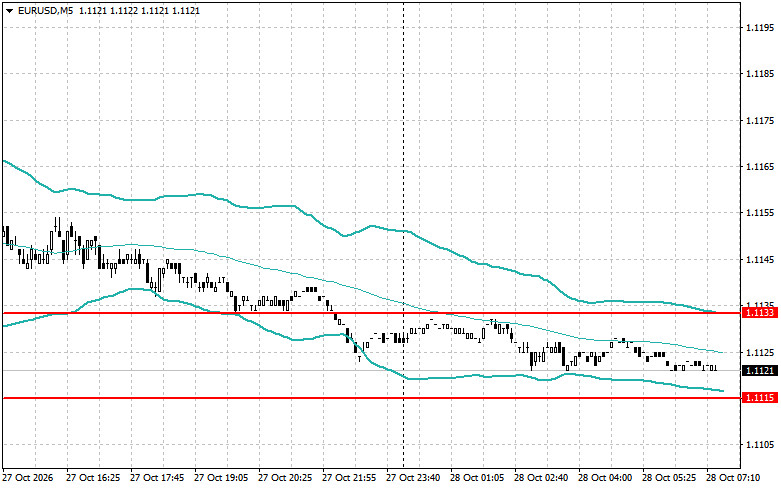
The dollar strengthened noticeably against the euro yesterday, and the pair lost another roughly 30 pips overnight, falling to about 1.1121. The euro again played the laggard.
The main surprise was the Conference Board consumer-confidence index for October. This survey of U.S. households on incomes and the labor market jumped to 91.7 versus an 80.5 forecast (84.2 in September). Such data matter doubly for the market because household spending is the main engine of U.S. growth—when consumers feel confident, they keep spending. Durable-goods orders for September also surprised to the upside, rising 1.8% versus a 0.6% forecast, which implies businesses are willing to invest in equipment. New-home sales also beat expectations (676k versus 649k forecast). No release disappointed, so the dollar received broad-based support.
The euro had no comparable trump cards. Neutral figures on lending and money supply were ignored, and Christine Lagarde remained cautious ahead of the European Central Bank meeting. The ECB decision is due tomorrow, and most participants expect a pause, so the single currency is unlikely to get much support from that event. The euro now looks like an athlete stepping to the line without a warm-up while the opponent is already up to speed.
From European data today, we only have Germany's GfK consumer-climate index for November. This survey of roughly 2,000 people gauges Germans' willingness to spend and save. Because private consumption drives Europe's largest economy, the GfK index is an early indicator of retail sales and GDP. The consensus is -30.1 after -30.6 in October—only a marginal improvement, and the level remains deeply negative, indicating consumer sentiment has not recovered.
Such a reading is unlikely to help the euro much because Germany's recent picture is mixed. The Ifo index rose to 90.2 on Monday, but the current-conditions component fell to 88.8, and Germany's composite PMI dropped to 52.8 from 53.8 on Friday. Even a small uptick in GfK will not erase those worrying signals. In my view, until the Federal Reserve decision and the ECB meeting, the pair will follow dollar sentiment, and the GfK print will only slightly tweak the short-term tone.
For the euro, the price is now at 1.1121, near the day's low. It's only six pips to the lower breakout level at 1.1115 and fifteen pips to the upper level at 1.1136. The downside reference is 1.1115. A break and hold below it could push the pair to 1.1082 and then 1.1036. I view this downward direction as primary because the backdrop is weighing on the euro and yesterday's U.S. data set a strong tone. But a reminder for beginners: the price is very close to the level, and the first touch isn't a confirmed breakout. You need to see the pair sustain below before calling a continuation of the fall. The upside reference is 1.1136; a break above it would open the way to 1.1155 and 1.1176. Such a rebound would require either dovish words from Warsh or a materially stronger GfK print, and I regard that scenario as unlikely, so I treat it as a secondary case.
Upside reversion level: 1.1133, which sits only three pips below the breakout point 1.1136, so special care is required. Three pips is market noise, and on the first touch you cannot distinguish a breakout from a reversion. If price reaches 1.1133, then clears 1.1136 and decisively holds above, that is a confirmed breakout and selling is off the table. If it merely touches the zone, fails, and quickly falls back, the reversion plays — I would look to sell with a stop above the high of the failed attempt.
Downside reversion level: 1.1115 coincides with the breakout-sell level, and the picture is most ambiguous here. The same price can give two opposite scenarios. If the pair moves below 1.1115 and holds there, that's a breakout and buying is off the table. If it briefly dips below, finds no follow-through and returns above, the reversion works, and I would consider long positions with a stop under the low of the failed attempt. You can only tell which scenario is playing out by what happens after the touch, so I would skip the first reaction in this zone. Given the overall backdrop, I expect any bounce to be modest and view continuation lower as more likely.

LINKS RÁPIDOS









 Contate-nos