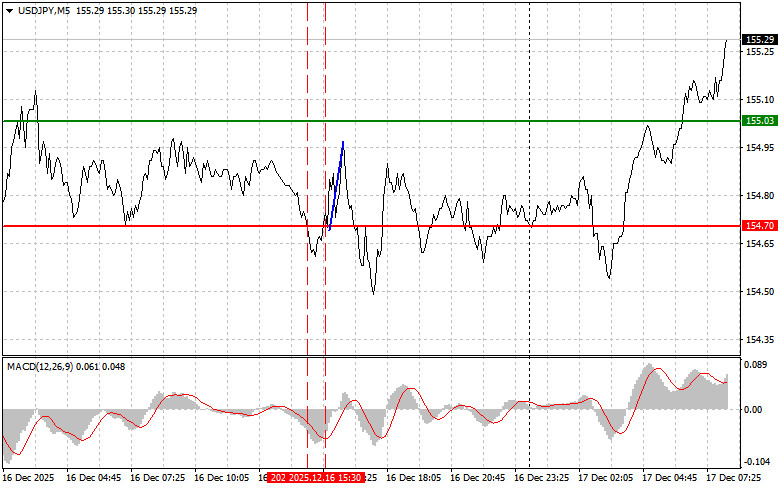
The price test at 154.70 coincided with the moment when the MACD indicator had fallen significantly from the zero mark, limiting the downward potential of the pair. The second test at 154.70 occurred when the MACD was in the oversold area and recovering from there, which allowed for the execution of Scenario No. 2 to buy dollars. As a result, the pair rose by 25 pips.
The Japanese yen only slightly strengthened against the U.S. dollar after news that the U.S. unemployment rate had risen again. This data heightened expectations that the Federal Reserve would continue to adopt a more cautious stance regarding interest rates.
In contrast, the Japanese yen strengthened amid its status as a safe haven and anticipation of the Bank of Japan's interest rate increase this Friday. Overall, the current situation in the currency markets reflects a complex interaction of economic factors and central bank decisions. Further dynamics will depend on upcoming economic data, decisions by the Fed and the Bank of Japan, as well as the overall situation in the global economy. Today's reaction of the yen to the positive dynamics of machinery and equipment orders in Japan rising against the dollar is a direct testament to this.
Regarding the intraday strategy, I will rely more on the execution of Scenarios No. 1 and No. 2.
Scenario No. 1: I plan to buy USD/JPY today upon reaching the entry point around 155.40 (green line on the chart), with a target rise toward 156.09 (thicker green line on the chart). Near 156.09, I plan to exit long positions and open shorts in the opposite direction (anticipating a 30-35-pip move back from the level). It is best to resume buying the pair on corrections and significant USD/JPY drawdowns. Important! Before buying, ensure that the MACD indicator is above the zero mark and just starting to rise from it.
Scenario No. 2: I also intend to buy USD/JPY today if there are two consecutive tests of 155.04 while the MACD indicator is in the oversold area. This will limit the downward potential of the pair and lead to a market reversal upwards. A rise toward the opposite levels of 155.40 and 156.09 can be expected.
Scenario No. 1: I plan to sell USD/JPY today only after the 155.04 level is updated (red line on the chart), which will trigger a rapid decline in the pair. The key target for sellers will be the 154.57 level, where I plan to exit shorts and immediately open longs in the opposite direction (anticipating a 20-25-pip reversal from the level). It is better to sell as high as possible. Important! Before selling, ensure that the MACD indicator is below the zero mark and just starting to decline from it.
Scenario No. 2: I also plan to sell USD/JPY today if there are two consecutive tests of 155.40 while the MACD indicator is in the overbought area. This will limit the upward potential of the pair and lead to a market reversal downwards. A decline toward the opposite levels of 155.04 and 154.57 can be expected.
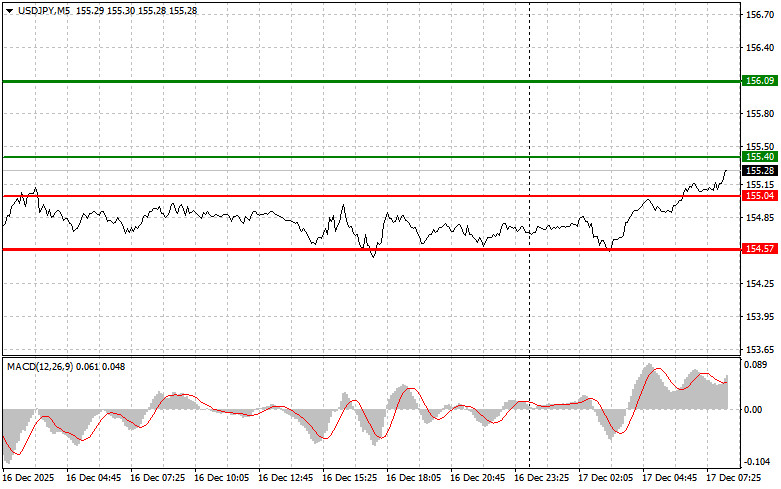
What is on the Chart:
Thin green line – entry price at which to buy the trading instrument;
Thick green line – estimated price where take profit can be set, or profit can be realized, as further growth above this level is unlikely;
Thin red line – entry price at which to sell the trading instrument;
Thick red line – estimated price where take profit can be set, or profit can be realized, as further decline below this level is unlikely;
MACD indicator. When entering the market, it is important to be guided by overbought and oversold zones.
Important: Beginner traders in the Forex market must be very cautious when making entry decisions. It is best to stay out of the market before significant fundamental reports to avoid sharp currency fluctuations. If you decide to trade during news releases, always set stop orders to minimize losses. Without setting stop orders, you can quickly lose your entire deposit, especially if you do not use money management and trade in large volumes.
And remember, successful trading requires a clear trading plan, similar to the one presented above. Spontaneous trading decisions based on the current market situation are inherently a losing strategy for intraday traders.

QUICK LINKS



















 Contact Us